Part One
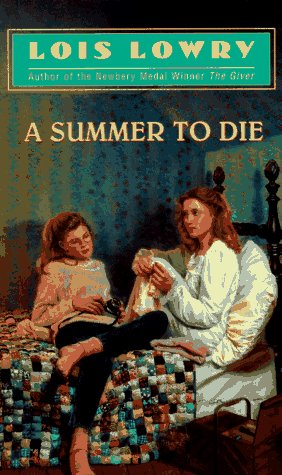
Book Information: Lowry, L. (1977). A Summer to Die. Boston: Houghton Mifflin
Genre: Young Adult Fiction
Lowry drew upon her own experience of
losing her sister at a young age when writing this novel. She stated, “A Summer to Die
wrenched open the excruciating door of loss. My beloved sister had died young.
She was the one who had shown me how words work, using her own first-grade
books, when I was three; the one who took up Cherry Ames and curlers while I
stuck to my classics and unkempt pigtails and we were briefly, childishly,
estranged.”
Grade Level: Suited for grades 6 and beyond!
Part Two
Response to Book: Personal
connections, predictions, and thoughts about the book’s theme!
When I selected this book to read for
this assignment I immediately noticed that the title revealed the result of the
climactic event of the story. At first I didn’t understand why the author had revealed
the tragedy in the title, although once I read the book I understood why. The
title can most likely make readers, especially young readers, turn way, however
it also catches the attention of readers who may be going through a similar
situation. I think the title of this book reaches out to those people as almost
to say “Read me! I can help you through it!” I think people, like myself, will
have a personal connection with this book. I also think the title prepares readers
for the tragedy in a way. Before reading you know that someone, perhaps a main
character, is going to die. Once Meg’s sister Molly becomes sick, it becomes
obvious. You know the result and can prepare yourself for her death. However,
knowing the result probably won’t stop you from crying when Molly passes away.
The novel embodies a true young
adult novel by confronting themes like jealously, sibling rivalry, friendship (making
human connections), individuality, life-changing moments, family relationships,
and death of a loved one. Here’s a quote from the novel
that I think perfectly encapsulates the theme and resolution.
“Time goes on, and your life is still there, and you have to
live it. After a while you remember the good things more than the bad. Then,
gradually, the empty silent parts of you fill up with sounds of talking and
laughter again, and the jagged edges of sadness are softened by the memories.”
Part Three
Critique
Overall, A Summer to Die is a great young adult novel. It is so touching, honest, and simple.
It is very important
for children to learn how to deal with different difficult situations and
emotions, and one way they can start to learn coping methods is by being
introduced to these types of situations and what a better way than through a
book! Also, Meg and Molly are relatable characters. This is the beauty of this
book! Meg’s feelings and her family are portrayed in a believable way, probably because parts of the novel, especially Meg and Molly’s relationship, are autobiographical.While the novel deals with a serious subject, a family coping with the
death of one of its members, the book is not depressing. The book’s hopeful
tone is attributable to Meg’s close relationship with her parents, her
friendships with kind and nurturing adults outside her immediate family, and
her own personal growth. A truly great novel for all!
Part Four
Lesson Sketch
Grade: 6th
Lesson
Objectives:
Students will:
- Learn and apply the comprehension strategy of making connections
- Define and understand the three types of connections (i.e., text-to-self, text-to-text, and text-to-world)
- Make connections and react to various texts using a double-entry journal
Lesson Outline:
Explain the strategy. Explain to students
that there are three main types of connections that we make while reading
texts. Use the making connections posters while discussing each type with your
students.
- Text-to-text connection: This reminds me of something else that I read....
- Text-to-self connection: This reminds me of when I....
- Text-to-world connection: This makes me think about....
- Demonstrate the strategy. Display a blank copy of the Double-Entry Journal and demonstrate how to use this technique. Explain to students that, in the first column, they should choose a quote or situation from the text that they can react to. Then, in the second column, they should record their reaction. Reinforce the fact that these reactions should make a connection between the text and themselves, another text, or the world. (Refer back to the making connections posters during this demonstration and discussion.)
- Read aloud the first few pages of “A Summer to Die” and model the process of completing the double-entry journal.
- Guide students to apply the strategy. Have students begin offering their reactions to the text as a way to practice the technique together as a class. Have students take part in completing the double-entry journal together.
- Practice individually or in small groups. As you continue reading the story, stop every few pages and ask students to record their reactions to the text on their own copies of the double-entry journal and then share their reactions with their group. Continue reading and stopping periodically for reactions until the story is finished.
Discussion:
- Describe the relationship between Meg and Molly? How are they different? How are they alike?
- What are signs that Molly's condition is worse than Meg thinks? Why does Meg continue to think that Molly will recover?
- Why do Meg's parents keep Molly's real condition from her? Would it have been better if Meg's parents had told her the truth about Molly's condition all along? Why or why not?
- Why is Meg's relationship with Will important? Why does he want her to come back in October to see the fringed gentian in bloom? What symbolism is attached to that event?
- Why do Ben and Maria ask Meg to take pictures of their baby being born? Why does Ben show Meg where they will bury the baby if it doesn't live?
- There are many emotional passages in the book. One of the most poignant is when Meg realizes that...
Links

No comments:
Post a Comment