Pages

Wednesday, April 30, 2014

Challenged Books - "The Witches" by Ronald Dahl

Part One
Book Information: Dalh, R. (1983). Witches. London: Jonathan Cape.

Genre: Fantasy, Challenge/Banned book: #22 on the 100 most frequently challenged books 1990–1999. The reasons for the banning/challenge:
In the book, “the children misbehave and take retribution on the adults and there's never, ever a consequence for their actions”
The Witches is “satanic”
The book might “entice impressionable children into becoming involved in the occult”

Grade Level: I recommend this book for 3-5 grades, it might be a little bit scary for some, but it has a very humorous feel great for a young audience.

Part Two
Response to Book: My predications and thoughts about the book’s issues/themes!
I was familiar with Dahl’s other books like the Big Friendly Giant, Charlie and the Chocolate Factory, and Matilda. This is another one of my favorites! I cannot believe that this book was banned for witchcraft. The villains of the story are witches; therefore witchcraft isn’t being promoted but is instead seen as pure evil. Although, the introduction of the story does mention that witches are very much real, I do not think this book belongs on the banned/censored book list. I think Dahl said it best when he replied to the challengers saying, “This book is a fantasy and an enormous joke.” I do not think the book’s ideas and premise was to be taken seriously. The entire plot seems like a silly and humorous situation. For children, I think that one of the main attractions will be that the book excites their imagination. It is at times an inversion of reality. For example, being clean is considered a bad thing and the main character goes weeks without washing. Furthermore, Dahl gives the witches a variety of shocking, unbelievable features, such as having no toes, blue spit and turning children into hotdogs, which will leave children astonished and very amused. I think this book doesn’t promote the belief in witchcraft, but promotes the importance imagination.

Part Three
Critique
I think this is a very interesting and entertaining book that Dahl has written. He uses tons of descriptive language and takes you through the story of a young boy who learns that there are witches in his world who are extremely hard to identify, although there are several signs, which his grandmother tells him, that can help one to identify a real witch. The whole plot is a flight of the imagination and humor. The witches in the story despise children and aim to get rid of them by sniffing out their scent. The boy ends up at a hotel that is hosting a witches convention. The bond between main character, the boy, and his kind-hearted grandmother become the centerpiece of the story. This is a partnership of love and understanding that survives even the boy's unfortunate transformation into a mouse. Despite this transformation the boy remains optimistic saying "It doesn't matter who you are or what you look like, so long as somebody loves you." I think this was a wonderful message to teach to children. This book teaches children to be hopeful, creative, and optimistic as well as the importance of the imagination. It reminds children they can be heroes and that imagination is essential to survival. Imagination fuels the soul and expands the mind. Another wonderful thing about this book is the main character has no name. Nowhere does it mention a name, which I thought was an interesting aspect. It's wondrous to me that a writer can go through the entire story without giving a title to the main character, the hero. Teachers and parents could reinforce the importance of being alert and cautious of strangers (who may be witches!).


Part Four
Lesson Sketch

Grade: 5th

Lesson Objectives:
Students will:
  • be exposed to the issues of censorship, challenged, or banned books.
  • examine issues of censorship as it relates to a specific literature title.
  • critically evaluate books based on relevancy, biases, and errors.


Lesson Outline:
  1. From a teacher-selected list of grade-appropriate books from the Challenged Children's Books list, have groups of students select one of the books to read in literature circles, traditional reading groups, or through read-alouds.
  2. As the students read, ask them to pay particular attention to the features in the books that may have made them controversial. As students find quotes/parts of the book that they find to be controversial, they should add them to their T-Chart, along with an explanation of why they think that this area could be controversial.  On the left side of their T-Chart, they will list the quote or section of the book (with page numbers); on the right side of the T-Chart, they will write their thoughts on why this area could be seen as controversial.
  3. You may also choose to invite the students to use bookmarks (in addition to or instead of the T-Chart) , so they can record page numbers and passages as they read.

Discussion Questions:
  • Why do books get banned or challenged?
  • Discuss censorship and challenged/banned books, and as they read their selected text, listen for comments that indicate they are identifying specific examples from the story that connect to the information they have learned.

Links to Outside Sources:

Sunday, March 30, 2014

Graphic Novel - "The Arrival" by Shaun Tan


Part One
Book Information: Tan, S. (2007) The Arrival. South Melbourne: Lothian Books.

Genre: Wordless Graphic Novel, Historical Fiction, Multicultural

Grade Level: 4th and up, suited for upper elementary of middle school because of the complex concepts depicted by pictures (readers have to figure out the story through pictures only)

Part Two
Response to Book: Reflection, personal connections, and thoughts about the book’s theme!

The Arrival illustrates a universal immigrant experience. The novel serves as a tribute to anyone who has left their home and loved ones behind in search of a better life in a foreign land. The novel’s main theme, which resonates with most immigrants, is “the hope and opportunity of finding a better life for you/ your family.” The story follows the journey of a man from his home country to a confusing new country. The man enters a world unfamiliar to him and encounters weird creatures, foods, a strange language, and social customs. I believe his experience is comparable to any immigrant in our world today and the past. What I loved about this book was it ability to effectively give its readers an opportunity to understand what it would be like to be an immigrant. The journey and emotions of the main character are understood without any words. Even without words this book is simply amazing! Readers begin to feel what the main character feels because the objects and language that appear in the new country are foreign to you also. Examples of these foreign (alien-like) objects, including buildings, streets, animals, trees, etc. are found in the pictures below.
Readers feel the loneliness, alienation, and determination of the main character during his immigration experience. Every obstacle the character faced I felt like I was facing. Every emotion the character felt, I felt as well.

This novel made me think of my own family’s immigration experience. My great grandfather, Domenico Collosi, emigrated from Pollina, Sicily in 1913 through Ellis Island in New York. My grandmother and grandfather, on my other side, both emigrated from Holland in 1957. After reading this book I felt like I could connect to those relatives in a way I couldn’t before. I was able to understand some of the experiences my family had to go through on their journey to foreign land and the obstacles they faced once they were here. The part of the story when the main character has to draw things down in order to communicate reminded me of grandmother. My grandmother, who only spoke Dutch when she came to America, had particular trouble learning English. She said their were many interpreters for Spanish and Chinese, but very few for Dutch. Her parents ended up hiring an English tutor for her and her sisters. Although, even after practicing with the tutor, she still had trouble with words like “shirt” and “skirt.” I feel that this novel gives the audience a powerful tool. The ability to connect with loved ones who have immigrated. In my opinion, any individual who has immigrated or has family that immigrated will appreciate the perspective of the novel. It is a truly powerful and meaningful story.

Part Three
Critique
Overall, I believe The Arrival is a stunning wordless graphic novel appropriate for all ages. The illustrations and photo realism is breathtaking. The time the illustrator spent on each image seems like hours or days! The sketches do not have color but instead are sepia-toned like old pictures. Even the edges of the paper are worn and damaged as if these illustrations were saved for many years. This aspect was appealing because it felt like you were looking at an old photo album of a relative’s immigration experience. The illustrator also creates extravagant illustrations for emphasis and symbolism. Often the images are surreal, strange, and alien-like, although, there is still a familiar quality to them.

There are no words in this novel so the sepia-toned sketches convey the story. The illustrations allow the audience to feel empathy for the main character. The images portray sadness, fear, confusion, wonder, curiosity, joy, and hope. The novel relies on the reader’s interpretations of these illustrations to complete the experience. The audience has to apply their own powers of perception and create the narrative in their minds. This was a unique aspect because it forces the reader to figure out the story through the eyes of the main character. Essentially the reader becomes an immigrant as well (because of the absence of words). The character tackles several obstacles throughout the story that are common of an immigrant. I think a powerful part of the story is when he was examined, catalogued, and labeled upon his arrival. I also think the symbolism of the giants (seen in the picture below) was also a significant part. The purpose of his journey, and theme of this novel, is universal for most immigrants. He leaves his home and loved ones in the hopes of finding a better life for his family in new country.


Part Four
Lesson Sketch

Grade: 5th

Lesson Objectives:
Students will:
  • Develop knowledge of some of the trials and hardships that immigrants encounter in the United States.
  • Be able to infer and interpret different themes that occur in the graphic novel The Arrival by Shaun Tan.
  • Be able to respond in written form to a prompt

Lesson Outline:
  1. Students write down their predictions in the notebooks for a few minutes.
  2. Read The Arrival by Shaun Tan. Stop and discuss significant images in the novel. Discussion should happen throughout because it is wordless. Students should write down what is happening in their notes.
  3. At the end of the reading have students write down whether their predictions were true.
  4. Students will respond to the following prompt: What is the overall theme of the story?  Was the author was trying to place us in the immigrant’s shoes? Why or why not?  Why were they building and other objects so strange?  Why were the people the only things that looked normal? Draw pictures if necessary.
  5. Collect students’ work. 

Discussion Questions:
  • How do you think these pictures relate to immigration? 
  • What are the underlying concepts presented in this story about the immigrant experience? 
  • How do you think this picture relates to what we are studying? 
  • What do you think the author’s message is? 
  • How does the main character react to the new and foreign land? List some of the strange elements the main character confronts and overcomes/adapts to.
  • Why do some of the pictures have darker backgrounds? (These indicate moments and events that have happened in the past)
  • Why do you think the author chooses to include flashbacks/memories of some of the supporting characters? Why are they important and what do they suggest about the new land?
  • When arriving in a new environment, there are many obstacles that one will face, including problems with communication. Find one or two instances where the language barrier presents a problem for the main character. 

Links to Outside Sources:

http://www.shauntan.net/books/the-arrival.html Shaun Tan’s comments about his book
http://www.ellisisland.org/Immexp/index.asp The Immigrant Experience! This is a rich and moving story of American Immigration. Six stories of Americans from different backgrounds researching immigrant ancestry. Discovery of distant family members gave each of these Americans new insights into their families’ pasts and into themselves.
http://www.pbs.org/independentlens/newamericans/newamericans.html Meet New Americans! Follow the stories of several immigrants who become American citizens. Watch their videos, takes the quizzes, and find out where they are now. 

Sunday, March 23, 2014

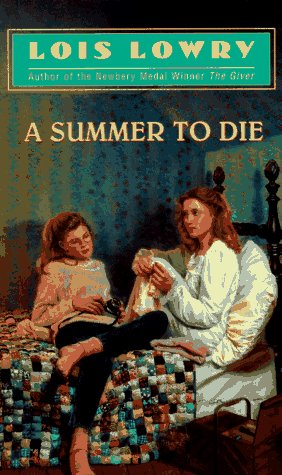
Pre-1990 Young Adult Book - "A Summer to Die" by Lois Lowry


Part One

Book Information: Lowry, L. (1977). A Summer to Die. Boston: Houghton Mifflin


Genre: Young Adult Fiction


Lowry drew upon her own experience of losing her sister at a young age when writing this novel. She stated, A Summer to Die wrenched open the excruciating door of loss. My beloved sister had died young. She was the one who had shown me how words work, using her own first-grade books, when I was three; the one who took up Cherry Ames and curlers while I stuck to my classics and unkempt pigtails and we were briefly, childishly, estranged.”


Grade Level: Suited for grades 6 and beyond!


Part Two
Response to Book: Personal connections, predictions, and thoughts about the book’s theme!
When I selected this book to read for this assignment I immediately noticed that the title revealed the result of the climactic event of the story. At first I didn’t understand why the author had revealed the tragedy in the title, although once I read the book I understood why. The title can most likely make readers, especially young readers, turn way, however it also catches the attention of readers who may be going through a similar situation. I think the title of this book reaches out to those people as almost to say “Read me! I can help you through it!” I think people, like myself, will have a personal connection with this book. I also think the title prepares readers for the tragedy in a way. Before reading you know that someone, perhaps a main character, is going to die. Once Meg’s sister Molly becomes sick, it becomes obvious. You know the result and can prepare yourself for her death. However, knowing the result probably won’t stop you from crying when Molly passes away.

The novel embodies a true young adult novel by confronting themes like jealously, sibling rivalry, friendship (making human connections), individuality, life-changing moments, family relationships, and death of a loved one. Here’s a quote from the novel that I think perfectly encapsulates the theme and resolution.
 “Time goes on, and your life is still there, and you have to live it. After a while you remember the good things more than the bad. Then, gradually, the empty silent parts of you fill up with sounds of talking and laughter again, and the jagged edges of sadness are softened by the memories.”

Part Three
Critique
Overall, A Summer to Die is a great young adult novel. It is so touching, honest, and simple.
It is very important for children to learn how to deal with different difficult situations and emotions, and one way they can start to learn coping methods is by being introduced to these types of situations and what a better way than through a book! Also, Meg and Molly are relatable characters. This is the beauty of this book! Meg’s feelings and her family are portrayed in a believable way, probably because parts of the novel, especially Meg and Molly’s relationship, are autobiographical.While the novel deals with a serious subject, a family coping with the death of one of its members, the book is not depressing. The book’s hopeful tone is attributable to Meg’s close relationship with her parents, her friendships with kind and nurturing adults outside her immediate family, and her own personal growth. 

A truly great novel for all!
Part Four 
Lesson Sketch

Grade: 6th
Lesson Objectives:
Students will:
  • Learn and apply the comprehension strategy of making connections
  • Define and understand the three types of connections (i.e., text-to-self, text-to-text, and text-to-world)
  • Make connections and react to various texts using a double-entry journal

Lesson Outline:
Explain the strategy. Explain to students that there are three main types of connections that we make while reading texts. Use the making connections posters while discussing each type with your students. 
  • Text-to-text connection: This reminds me of something else that I read....
  • Text-to-self connection: This reminds me of when I....
  • Text-to-world connection: This makes me think about....
  1. Demonstrate the strategy. Display a blank copy of the Double-Entry Journal and demonstrate how to use this technique. Explain to students that, in the first column, they should choose a quote or situation from the text that they can react to. Then, in the second column, they should record their reaction. Reinforce the fact that these reactions should make a connection between the text and themselves, another text, or the world. (Refer back to the making connections posters during this demonstration and discussion.)
  2. Read aloud the first few pages of “A Summer to Die” and model the process of completing the double-entry journal.
  3. Guide students to apply the strategy. Have students begin offering their reactions to the text as a way to practice the technique together as a class. Have students take part in completing the double-entry journal together.
  4. Practice individually or in small groups. As you continue reading the story, stop every few pages and ask students to record their reactions to the text on their own copies of the double-entry journal and then share their reactions with their group. Continue reading and stopping periodically for reactions until the story is finished.


Discussion:
  • Describe the relationship between Meg and Molly? How are they different? How are they alike?
  • What are signs that Molly's condition is worse than Meg thinks? Why does Meg continue to think that Molly will recover?
  • Why do Meg's parents keep Molly's real condition from her? Would it have been better if Meg's parents had told her the truth about Molly's condition all along? Why or why not?
  • Why is Meg's relationship with Will important? Why does he want her to come back in October to see the fringed gentian in bloom? What symbolism is attached to that event?
  • Why do Ben and Maria ask Meg to take pictures of their baby being born? Why does Ben show Meg where they will bury the baby if it doesn't live?
  • There are many emotional passages in the book. One of the most poignant is when Meg realizes that...


Links


Sunday, March 2, 2014

Batchelder Book - "A Game for Swallows" by Zeina Abirached


Part One
Book Information: Abrirached, Z. (2012). A Game for Swallows: To Die, to Leave, to Return. New York: Graphic Universe

Genre: Graphic Novel, Autobiographical

Grade Level: I would recommend this book for 6-8 grades because of the discussion of violence (bombings, snipers, kidnappings)

Part Two
Response to Book: My predications and thoughts about the book’s issues/themes!
This was my first graphic novel I have ever read and definitely wont be my last. It was different to read because my eyes were jumping all over the page looking at all the amazing illustrations and I had to get used to the rhythm of reading text while looking at the images. It might be unusual at first, but I think the author’s purpose is more powerful through this medium as opposed to normal text. For me, it was more emotional to learn about her story, and facts about the civil war in general, through the comics/graphics. It was also easier to relate to because the medium helped you visualize the way of life for the citizens in this country during this time. I especially liked the maps, showing the divide of the city and the illustrations of the paths people had to take to avoid the snipers. These were powerful to the story’s purpose to educate the audience about the conditions of the Lebanese civil war. Before reading I had no idea what to expect from this book. I never learned about the Lebanese civil war, ever. So not only was the genre new to me, but the topic was also. For a reader who was new to this subject I especially liked the snippets of information throughout the book where the author would pause from her story to talk about the way the lives of all the people in Beirut were changed. This way the audience understood the conditions of life and also learned more about the war itself.
I thought the theme of war would be difficult for a younger audience to understand or relate to. I think an older, middle school aged, audience would appreciate and comprehend the book more. The story is presented in a rich and powerful format that can be used by teachers to discuss many language arts and social studies concepts as well as introducing students to the genre/medium of graphic novels.

Part Three
Critique
Overall, I thought this book was an amazing way to present the civil war in Lebanon. There wasn’t much plot development to follow, but you become to care for all the characters. As a reader, you want to know if all the characters survive in the end because there is a great deal of uncertainty. At any moment, any of the character can become a casualty In the war. The author describes her own experiences as a child living in her apartment building in the middle of the civil war in Beirut, Lebanon 1984. I think it was powerful to hear the story from the perspective of the child because the children in the story don’t really know another way of life. I liked the fact that the readers get to hear the stories of all the neighbors in the building one-by-one as they take shelter in the foyer of the building together. Unlike the children in the story, the adult characters all remember how Beirut used to be and share memories of their lives before the war. It’s interesting to see how each person deals with the day-to-day aspects of living in a war zone, and how they come to deal this reality. Some feel like fleeing and others do not want to abandon their home. Most of the characters feel hopeful, so readers can’t help but to feel some sort of hope too. Choosing to do a graphic novel to tell this story was a great choice. I think the illustrations and graphics were essential to Abrirached’s story. They allowed the reader to connect emotionally to the book. For example, seeing the dialogue between the people who got stopped at the demarcation line, which was a normal occurrence then, was a significant part for me. When the person, who had no essential authority, asked the man driving to step out of the car, my heart sank. These moments in the story would be difficult for a young audience to understand, but would be easier for a middle school aged audience. I think the book was intentionally done in black and white because it was also a sad time. Although, I think the cartoon-like illustrations helped bring lightness to the story. I think the book would be vastly different if the characters and backgrounds looked realistic. It would almost be too severe for an audience, especially a young audience. However, I think the real pictures incorporated at the end were powerful send-off.


Part Four
Lesson Sketch

Grade: 6th

Lesson Objectives:
Students will:
  • Develop critical reading and thinking skills through engagement with the graphic novel in a multilateralism instructional framework
  • Develop and utilize visual literacy skills to aid and support reading comprehension and deepen understanding
  • Present personal interpretations and understanding in oral and written forms
  • Draw on personal experiences and literacy practices


Discussion Questions:
  • What was the purpose of “A Game for Swallows”? What message was the author trying to get across?
  • Why do you think the author wanted to share her story?
  • Why did she share her story through this medium?
  • What are the characteristics of graphic novels? Use examples from the story and others.


Lesson Outline:
  1. After reading “A Game for Swallows” with class and discussing the elements of graphic novels, student will be instructed to make their own autobiographically graphic.
  2. Students will begin a brainstorming process where they will think of the story they want to tell. They will then complete a pre-writing process that will be checked by the teacher.
  3. Students will then begin work on their graphics, on a blank sheet of paper (size depending on teacher preference). The students must incorporate the elements of a graphic novel into their story, such as text placement, dialogue, number of panels, illustration technique, color, etc.
  4. Their individual projects will be shared with the class.


Links to Outside Sources:
Using Comics and Graphic Novels in the Classroom. Understand how using comics and graphic novels can help teach complex reading skills, punctuation, outlining, paragraphing, and literary terms.

Bitstrip. Students can browse through other people’s comics and create their own at this site.

Sunday, February 23, 2014

Multicultural/Global Literature - “The Composition” by Antonio Skarmeta and Alfonso Ruano


Part One
Book Information: Skármeta, A. (2000). The Composition. Toronto, Ontario: Groundwood Books.
Genre: Fiction, Historical because Antonio Skármeta was born and raised in Chile during a time of dictatorship

Grade Level: 3-5, I would recommend this book to any teacher who wants a realistic portrayal of a country ruled by a dictator, or to teach multicultural/ global studies

Part Two
Response to Book: Reflection, predictions, and thoughts about the book’s themes!
Before reading the story, I examined the cover and back to search for images or information that might reveal what the story was about. The book cover gave a few clues as to what the story might be about. On the cover, a boy stands with a large paper in his hands while a few armed soldiers are in seen the background. The large piece of paper in the boy's hands on the cover and the title, The Composition, led me to believe the story had something to do with composing a piece of art or writing. I had no idea what the armed soldiers meant, however, you could tell by the boy’s face that the soldiers were not a friendly presence.

The story presents some complicated issues and topics that students may not be familiar with. The book explores powerful themes and issues of social justice, the innocence/maturity of children, bravery/taking social action, and becoming a part of a community. The story depicts a young boy, Pedro, who lives in a South American country under a dictatorship. At the beginning of the story, Pedro is innocent and naïve to his country’s oppression. "'Children aren’t against anything,’ she said. ‘Children are just children. They have to go to school, study hard, play and be good to their parents.’” These are the words of Pedro’s mother that emphasize his innocence.  He doesn’t seem to understand why all the adults in his community sit around the radio every day after work. This all changes when one day he sees his friend Daniel’s father being taken away by soldiers. This is a turning point in the story where we see Pedro losing his innocence in a sense. When he asks his parents about what happened, he learns that Daniel’s father, as well as his own parents, are against the government dictatorship. I thought it was interesting how Pedro starts to become a part of his community in this way because he is exposed to the social injustices of his country. At the end of the book, a man in uniform enters Pedro’s classroom and asks all the children to write a composition as part of a contest called “What my Family Does at Night.” Pedro is no longer an innocent and naïve child at this point. He has matured from the experience with Daniel’s father and knows the devious motives of the soldier. It is somewhat suspenseful because as an audience we do not know if Pedro is going to unintentionally disclose how his parents listen to the resistance on the radio at night. However, the readers discover that Pedro describes a very boring, and blatantly false story of what his family does at night in his composition. In the end, we see how brave and fearless Pedro is to take such action.

I think the book incorporates many multicultural and global experiences. Although the country where Pedro lives is not given directly, the audience can assume it is in South America. Pedro and his friends love to play soccer, or fútbol, which is one of the most important South American sports. The portrayal of the dictatorship is also significant. This book exposes its audience to a culture that has a different govenerment. This is especially important for American students to see in my opinion. It teaches students that different cultures and governments can be unpleasant and oppressive. It also allows students to see the injustices of these types of governments and appreciate the great democracy we live in. I think it is a very effective example of multicultural literature.


Part Three
Overall, I felt that this book was a great story to introduce students to a different culture, country, and government. I think it is a powerful story with an age appropriate depiction of a oppressive government and it's affects on the people. The setting is general enough to relate to anyone who has lived in a dictatorship. I think the author did this purposefully. There is an enormous amount of character development that we see, especially with Pedro. The language is also suitable for elementary students, although it is somewhat lengthy in parts. I liked how there was some humor to highlight the innocence of the characters. It thought this contrasted well with the more somber parts of the story. The illustrations were realistically done, with a hints of color for more emphasis. I think the story does a great job of depicting an oppressive country and the social injustices. 

Part Four 
Lesson Sketch

Grade: 5th

Lesson Objectives:
Students will:
  • Be able to define the words dictatorship and democracy mean
  • Provide examples from the book “The Composition” about dictatorship, and how it took control of people’s lives and their freedom
  • Describe the type of government that they live in
  • Be able to identify their rights and freedoms as individuals
Lesson Outline:
  1. Read the book “The Composition” by Skarmeta and Ruano.
  2. Talk to students more about dictators and how much power they have. Then show the government that we live in the United States. This is a good time to go over the governments branches to test students’ background knowledge on our government. Explain that our government is balanced out between many people who we have ELECTED as officials by voting.
  3. We will then designate one student to be the dictator for the day. This student will come up with a couple of ridiculous rules that all students must abide. If they do not they will have to face the consequences (which in this class may be sitting in a different chair across the room from the class.) But explain that in a real dictatorship this could mean being taken away from your family, like Pedro’s friend did in “The Composition” or you could even be killed. Examples of rules a student may use could be saying a specific word, such as the word desk or even another student’s last name.
  4. Discuss dictatorships and give students many examples of different influential dictators and how they ruled their countries. Show some pictures of people living in a dictatorship and how hard it must have been to live during these times.
Discussion:
Class will have a grand discussion about the positive things that come from living in a free country. Have students name some of the rights they have just for living in this country. Example: freedom of speech, freedom of religion or freedom of press. Make sure that students understand the consequences of acting a certain way in a dictatorship. Have students name off a few of the dictators they know of.

  • Complete this statement, “This book made me feel _____.”
  • Did Pedro let his small size bother him or did he use it to his advantage?
  • Do you think children can be against a dictatorship?  Why or why not?
  • If you were given the same assignment that Pedro received, what would you write?  What if you lived in Pedro’s country?  Would your essay be different?  Why or why not?
  • What was your favorite part of the book?  Your least favorite part?

Links to Outside Sources:


Advise and Consent-Limits of Power

http://www.learningtogive.org/lessons/unit3/le sson1.html

Bringing Down a Dictator
http://www.pbs.org/weta/dictator/classroom/le sson1.html
Dictator For a Day
http://school.discovery.com/lessonplans/progr ams/tlc-ancientrome/#que